Using Canva makes you an AI creator now?
I spent hours making my first Instagram carousel, and it got hit with an "AI content" label for using a background remover that's been in Canva for years. So I read the actual EU regulation to find out if Meta was right to flag me. Spoiler: the EU AI Act draws a much sharper line than Meta does.
Something weird happened to me a few days ago that I can’t get out of my head. As your resident loud person, and now having the space to talk about it, you’re in for a treat!
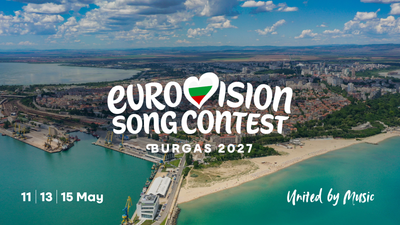
I was preparing an Instagram carousel for the blog post about Eurovision 2027 being held in Burgas using Canva and it was taking HOURS! It was taking hours because it was my first post announcing a blog article -> I was figuring out the aesthetics, trying my best to create a foundation for cohesive branding, all of that stuff. When I finally finished and published the post, this lil thing came up.

Excuse me? I was gooped and gagged at the sight of it. When I clicked on it to see for more information, this is what popped up:
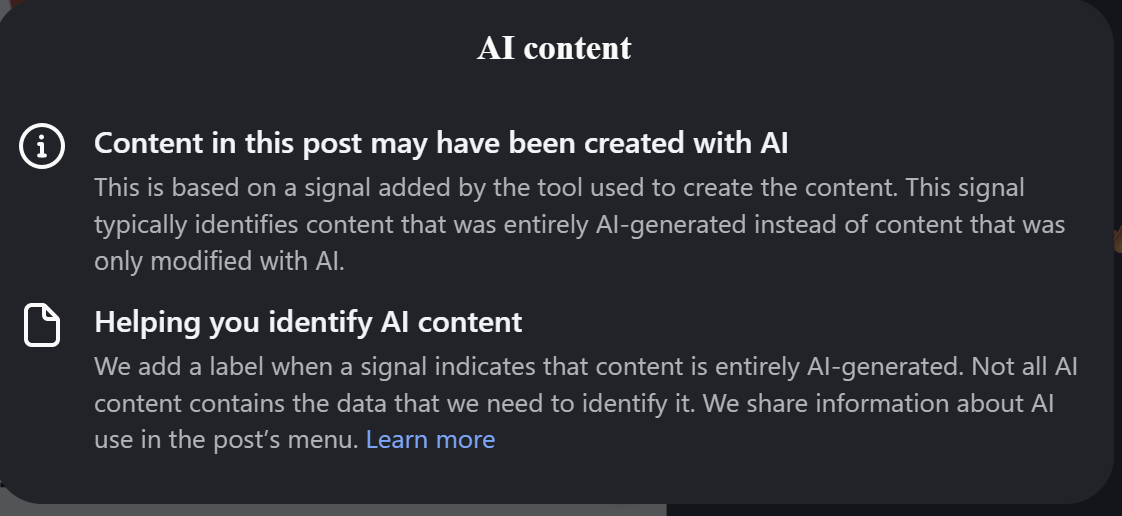
Sure! Let’s learn more.
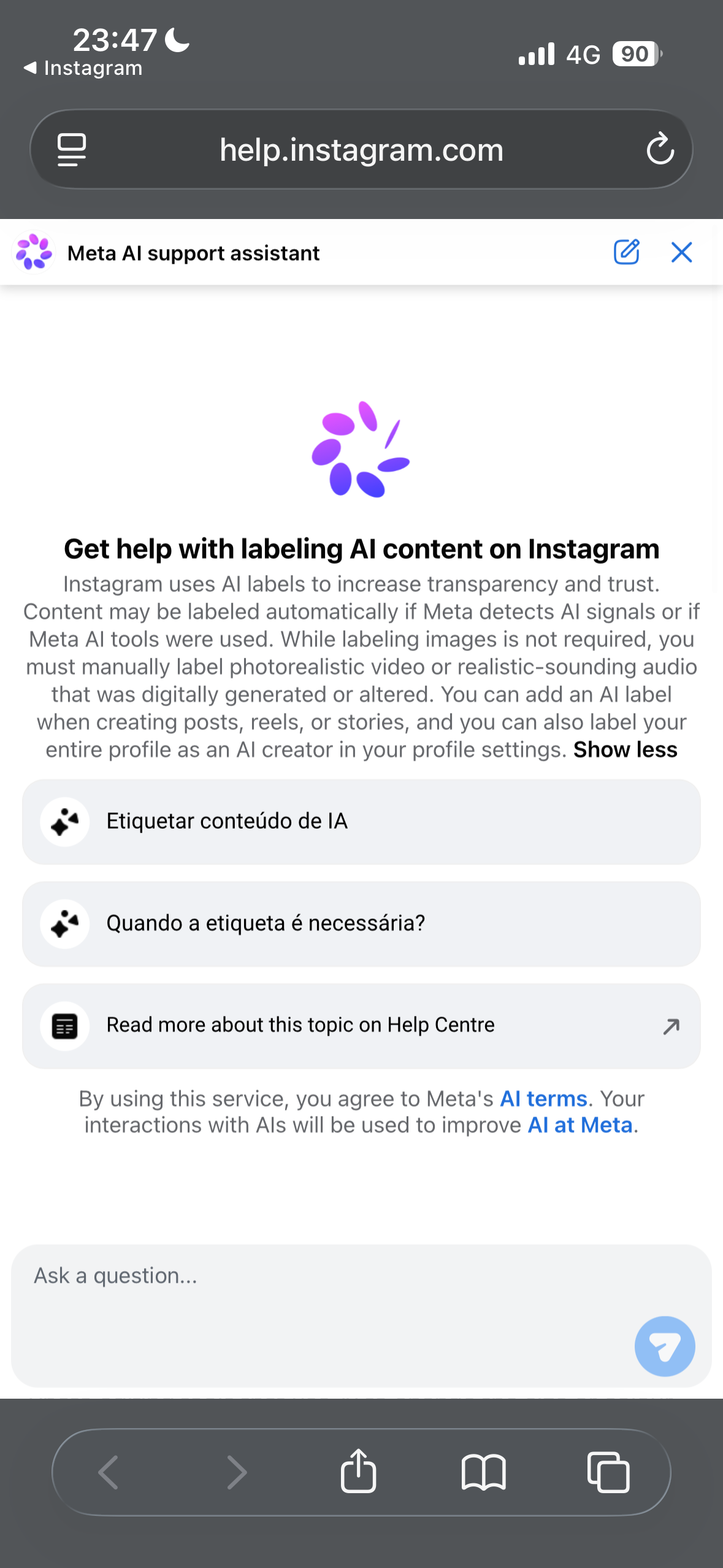
Of course, the AI label forwarded me to a page where I was met with an AI chatbot. I don’t know why it was talking to me in Portuguese, but I know that I will not be communicating with an AI chatbot about an AI label being added, assuming automatically, by an AI built LLM…some Inception stuff going on in here, huh? :D
But anyway, I tried to learn more about what’s happening! As someone who’s against the use of generative AI in art, it feels like a huge betrayal not only to the audience I’m trying to build, but to myself as a creator as well, to be accused of using AI in my content. I started asking questions: Did I do something wrong? Did I accidentally use an AI graphic somewhere, maybe I forgot to check one of them? Then I went through the graphics used in my post, and I couldn’t see any AI generated content by clicking on the “Info” field; that left me with more questions than answers, so I did what any scholar of social media would: I googled.

And the first result that came up did what it was supposed to do: provided an answer to my question but it also SHOCKED me. It’s a carousel created by iammichellegifford about the issue, mentioning that Meta now flags any content that’s used AI due to the latest regulation accepted in the EU, and Canva’s background remover, is allegedly, one of them.
How do we know this though? Michelle has not mentioned her source, so I checked another google search result just in case I can find some more information, and this carousel by thatjessbruno popped up! First thought: Okay, so I AM NOT THE ONLY ONE. After a deep breath and the sense of relief infused my body, I looked into the content itself. She’s contacted Meta directly via phone call, and the support agent has confirmed that using any AI “enhancement” tools in a post might trigger an “AI generated content” flag. Excuse me? I’ve of course used that several times, but using a tool that uses AI in an editing software is completely different than creating AI generated content - so how can the distinction be made and properly flag actual AI generated content?
To be honest, I didn’t even know that background remover uses AI - it’s been there for years! I checked – it’s been there since 2019! 1 That’s long before any of these other AI tools were created. But Jess confirmed with Canva and apparently now it also uses AI - why, when the feature used to work great without it, is beyond me - that’s a conversation we’ll have at some point in the future, but today’s not the day. In my journey, an Odyssey if you will, to understand what's going on, I looked into the regulation from 27.07.2026 2 (won’t bore you with most of it - I am also not a lawyer, therefore can’t properly interpret the law), and from what I was able to find:- In Chapter IV, Article 50, paragraph 4:
Deployers of an AI system that generates or manipulates image, audio or video content constituting a deep fake, shall disclose that the content has been artificially generated or manipulated. This obligation shall not apply where the use is authorised by law to detect, prevent, investigate or prosecute criminal offence. Where the content forms part of an evidently artistic, creative, satirical, fictional or analogous work or programme, the transparency obligations set out in this paragraph are limited to disclosure of the existence of such generated or manipulated content in an appropriate manner that does not hamper the display or enjoyment of the work.
Deployers of an AI system that generates or manipulates text which is published with the purpose of informing the public on matters of public interest shall disclose that the text has been artificially generated or manipulated. This obligation shall not apply where the use is authorised by law to detect, prevent, investigate or prosecute criminal offences or where the AI-generated content has undergone a process of human review or editorial control and where a natural or legal person holds editorial responsibility for the publication of the content.
From my understanding, that tells us the following: Any content that’s used AI in its creation should be disclosed. And that’s great! I don’t disagree with it - art should be left to the artists, as when such is created by people, it lasts in people’s hearts, not in a server somewhere around the world.
However, we need to properly differentiate between content created by someone prompting a LLMLarge language models (LLMs) are a category of deep learning models trained on immense amounts of data, making them capable of understanding and generating natural language and other types of content to perform a wide range of tasks. or VLMVision language models (VLMs) are multimodal, generative AI models capable of understanding and processing video, image, and text. model, and content created by people using softwares with embedded AI in them. And what’s funny is that the regulation kind of nods to it too - buried in the guidelines, under article 50, paragraph 2:“.....This obligation shall not apply to the extent the AI systems perform an assistive function for standard editing or do not substantially alter the input data provided by the deployer or the semantics thereof, or where authorised by law to detect, prevent, investigate or prosecute criminal offences.”
However, please keep in mind that this line is technically written for the company making the AI tool, not the content creator themselves, as paragraph 2 starts with “Providers of AI systems…,” which is a different target audience from what was said in paragraph 4 - so I’m borrowing the logic itself rather than the letter of the law.
And it’s a useful idea to borrow - the EU’s draft also spells out where the line sits. As I said, I am not a lawyer, so I googled the meaning of these stuff and found this great breakdown by Blue Arrow 3, a firm that specializes in AI regulatory compliance, who explains the three exceptions in marking synthetic content:- AI systems performing an assistive function for standard editing (grammar correction, format conversion, technical compression, minor cropping, minor colour adjustments, dust spot removal).
- AI systems that do not substantially alter the input data or its semantics.
- The third covers AI systems authorised by law to detect, prevent, investigate or prosecute criminal offences.
Essentially, as long as the content is not fully generated by a computer or substantially changing the content provided, a disclosure is not necessary. So if a photographer uses an AI tool in Lightroom to brighten a shadow, that's still their photo. If someone types "Cozy minimalist interior. 85 mm photo. Architectural Digest. closeup. colorful" 4 into Midjourney and hits enter, that's a completely different thing - they described a picture, and something else made it for them.“Anything that substantially alters the input data, including translations, summaries, composite imagery, semantic changes to existing content, addition or removal of objects, or pixelation of faces, is in scope.”
There is still a fuzzy part to me, which is the space between the two - specifically on the text side, which is much closer to what I do than when I simply make my Instagram post edits; there is a difference between someone typing “I have these thoughts and these sources of information, help me with systematizing them into a plan for a research paper on the topic of X” and “I want to write a research paper on the topic of X, do it for me”; a difference that if we bluntly label everything as “AI generated”, will spill through the cracks and the risk of falsely accusing someone of using AI, will be higher - therefore the disclosure itself loses meaning.
Which brings me back to my original problem, the wrongly-labeled Instagram carousel.
A background remover that’s been doing its job since 2019 is as “assistive function for standard editing” as it can get - no invention, no changing what the photo is, it literally just makes it look better for the type of edit one wants to create. By the EU's new regulation's own logic, that shouldn't need a disclosure at all.
But Meta didn't ask what the tool did to my image, or to Jesses. It relied on an automated detection system that probably takes into account all of the tools Canva has, sees the invisible watermark left from the platform, and slapped the same label on my carousel that it would slap on a fully Midjourney-generated one.
And apparently I’m now part of the case study, alongside all of the other content creators affected, that a regulation applied incorrectly can have a bigger impact on small creators than if we don’t have it. We still don’t know how that affects the reach and our engagement on Instagram, and who knows when we will.
The regulation drew a line between “assistive” and “substantial", yet the platform enforcing it didn’t bother doing the same. And that enforcement now means that “the used tool was capable of AI at some point”, rather than “this was AI-generated”, which will sadly become a category as broad as it’s long as more editing software starts bolting AI onto features that have worked fine for years.
So yeah, it’s disappointing that my post was flagged as generated by AI; as good as the regulation is and will be useful in the long run, disclosure only works if it's honest about what it's disclosing. If a background remover from 2019 and a fully prompted Midjourney render get the same badge, the badge is no longer protective - the people will just start ignoring it, which is worse than not having it at all.
Citations:
The Outlier corrects errors openly. Spotted something? Write to info@theoutlier.ink with the subject line "Correction - {article title}."

A PhD student with a broad spectrum of interests: from statistics to the simple pleasures in life.